
When a Nation Awakens: The U.S. Path Through World War II
- Pages: 7
- Word count: 1702
- Category: War
A limited time offer! Get a custom sample essay written according to your requirements urgent 3h delivery guaranteed
Order NowThe participation of the United States in World War II became one of the most significant factors in the victory of the Allied Powers and simultaneously a transformative event for the country itself. Although the U.S. entered the war later than other major nations and initially adhered to a policy of non-involvement, its economic capacity, military strength, and industrial mobilization eventually played a decisive role in determining the outcome of the global conflict. The war marked a turning point in American foreign policy, shifting the nation from isolationism to international leadership, while also reshaping society, technology, and the economy.
The aim of this essay is to examine the participation of the United States in World War II through the lens of its key components: the political and economic conditions that led to the country’s entry into the war, the major military campaigns involving American forces, the scale of internal mobilization, and the long-term consequences that influenced both U.S. development and global affairs.
From Isolationism to War: Why the U.S. Entered the Global Conflict
During the interwar period, the United States maintained a strong policy of isolationism, rooted in the widespread belief that European conflicts should not become American concerns. The heavy losses and economic hardships following World War I reinforced public sentiment against involvement in foreign wars. Both the general population and many members of Congress resisted any steps toward intervention.
However, the growing aggression of Nazi Germany, Fascist Italy, and militarist Japan gradually forced U.S. policymakers to reconsider their position. President Franklin D. Roosevelt recognized that strict isolationism might threaten national security. Throughout the late 1930s and early 1940s, he cautiously pushed the country toward closer cooperation with nations resisting Axis expansion. Initiatives such as the “cash and carry” policy and especially the Lend-Lease Act allowed the U.S. to supply weapons, equipment, and raw materials to Great Britain, the Soviet Union, China, and other Allied nations.
Despite these steps, most Americans remained firmly opposed to entering the war—until the morning of December 7, 1941, when the Japanese attack on Pearl Harbor changed public opinion overnight. The strike destroyed a significant portion of the U.S. Pacific Fleet and demonstrated the vulnerability of the nation. Congress declared war on Japan the next day, and soon afterward Germany and Italy declared war on the United States. With these declarations, the U.S. was drawn into a global conflict on two theaters: the European front and the Pacific.
Thus, American entry into World War II was the result of a complex mix of international threats, strategic calculations, and the realization that isolationism was no longer viable in a rapidly changing world.
Major American Military Operations in Europe and the Pacific
After entering the war, the United States faced the strategic challenge of fighting two powerful adversaries simultaneously. In cooperation with Great Britain and other Allied nations, American military leadership adopted a “Germany-first” strategy, prioritizing the defeat of Nazi Germany before focusing the full force of the U.S. military on Japan.
European Theater
On the European front, the United States took part in several crucial operations that shaped the outcome of the war:
-
North African Campaign (1942–1943)
The first major operation for American ground forces. It allowed the Allies to defeat Axis troops in Africa and prepare for the invasion of Southern Europe. -
Italian Campaign (1943–1945)
Following the Allied invasion of Sicily, American and British forces opened a new front in Italy. The campaign led to the collapse of Mussolini’s regime and forced Germany to divert troops from other key areas. -
Normandy Invasion—D-Day (June 6, 1944)
Operation Overlord marked the largest amphibious landing in history. The successful landing created a Western front and began the liberation of France and other occupied territories. -
Battle of the Bulge (1944–1945)
The largest and bloodiest battle fought by the U.S. Army in Europe. American forces repelled Germany’s final attempt to reverse the course of the war.
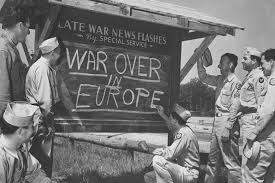
By the spring of 1945, American and Allied troops had crossed into Germany, and in April U.S. and Soviet forces met at the Elbe River, symbolizing the approaching end of the conflict in Europe.
Pacific Theater
In the Pacific, the United States faced a technologically advanced and ideologically motivated Japanese military.
Key operations included:
-
Battle of Midway (1942) — a decisive turning point that crippled Japan’s naval superiority.
-
Guadalcanal Campaign (1942–1943) — the first major American offensive against Japan.
-
Island-hopping strategy — the systematic capture of strategically important islands, allowing the U.S. to move closer to the Japanese mainland.
-
Battles of Iwo Jima and Okinawa (1945) — extremely costly campaigns demonstrating the enormous losses expected in the event of a direct invasion of Japan.
The decision by President Truman to use atomic weapons against Hiroshima and Nagasaki in August 1945 led to Japanese surrender. The moral and political implications of this decision remain subjects of intense debate.
Industrial Mobilization, Social Transformations, and Scientific Progress
The home front became just as important as the battlefields. Wartime mobilization brought rapid economic growth, social change, and unprecedented technological development.
Economic Transformation
Once the U.S. entered the war, its industrial base expanded dramatically. Factories that once produced consumer goods were reoriented to manufacture tanks, aircraft, ships, and ammunition. The United States earned the title “Arsenal of Democracy”, producing more military equipment than all Axis powers combined.
Mass mobilization created millions of jobs, effectively ending the Great Depression. Workers migrated to industrial centers, shipyards, and aviation factories, transforming the demographic landscape.
Social Changes
The war reshaped American society in several important ways:
-
Women in the Workforce
With millions of men drafted, women entered factories, transportation, and technical fields in unprecedented numbers. “Rosie the Riveter” became a symbol of women’s contribution to the war effort. Although many returned to traditional roles after 1945, the experience laid the groundwork for future advancements in women’s rights. -
African Americans in Industry and the Military
African Americans gained greater access to industrial jobs and military service, contributing to the war effort and strengthening demands for civil rights. The “Double V” campaign — victory abroad and victory at home — highlighted their desire for equality. -
Internment of Japanese Americans
Over 100,000 Japanese Americans were forcibly relocated to internment camps. This remains one of the most serious violations of civil liberties in U.S. history and later became the subject of official apologies and compensation.
Technological and Scientific Breakthroughs
World War II accelerated scientific research, including:
-
the Manhattan Project, leading to nuclear weapons,
-
advances in aviation, radar, and communications,
-
development of new medical and industrial technologies,
-
breakthroughs in cryptography and electronics.
These achievements shaped the technological landscape of the postwar world.
Postwar Global Influence and Transformation of U.S. Foreign Policy
The end of the war marked the beginning of an entirely new era for the United States. As one of the principal victors, the country helped shape the political and economic architecture of the postwar world.
Creation of International Institutions
The United States played a leading role in establishing:
-
the United Nations,
-
the International Monetary Fund,
-
the World Bank,
-
the Bretton Woods system.
These institutions promoted global stability and positioned the U.S. as a central force in international politics.
Beginning of the Cold War
Despite being wartime allies, the United States and the Soviet Union soon found themselves in a state of geopolitical rivalry. The ideological and political differences between the two nations gave rise to the Cold War, which dominated global politics for decades.
Economic Leadership
By 1945, the U.S. possessed the world’s most powerful economy, its industrial capacity intact and greatly expanded. American economic power became the foundation for European recovery through programs such as the Marshall Plan.
Comparative Table
| Aspect | Key Characteristics | Significance |
|---|---|---|
| Foreign Policy | Shift from isolationism to intervention | Formation of the Allied coalition |
| Military Strategy | European and Pacific theaters | Major contribution to the defeat of the Axis |
| Economic Mobilization | Full industrial transformation | End of the Great Depression; rapid growth |
| Social Change | Women, African Americans, internment | Long-term social and political reforms |
| Scientific Progress | Manhattan Project, technological advances | Beginning of the nuclear age |
| Global Influence | Postwar institutions, leadership | Emergence of the U.S. as a global power |
Conclusion
The participation of the United States in World War II was a decisive factor in the defeat of the Axis Powers and a transformative episode in American history. The war reshaped national policy, propelled scientific and technological innovation, altered social structures, and established the United States as a leading global actor.
The consequences of this involvement extended far beyond the battlefield. They shaped international institutions, influenced U.S. foreign policy for decades, and laid the foundation for America’s role in the modern world. Understanding the breadth and complexity of U.S. participation in World War II is essential not only for historical knowledge but also for interpreting global politics today.