
The Decline of Handwriting and Its Cognitive Consequences
- Pages: 7
- Word count: 1711
- Category: Education
A limited time offer! Get a custom sample essay written according to your requirements urgent 3h delivery guaranteed
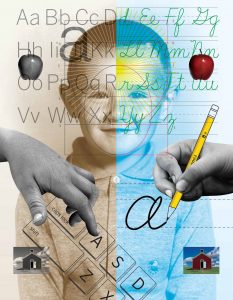
Order NowHandwriting used to be such a normal part of everyday life that no one questioned its importance. Children learned cursive in school, adults wrote letters and filled notebooks, and taking notes by hand was the default mode of learning. Today, however, writing by hand is steadily losing ground to keyboards, touchscreens, and voice typing. Laptops dominate university lecture halls, elementary students practice typing earlier than ever, and entire generations rarely use pen and paper outside of exams.
This shift is more than just a change in tools—it represents a transformation in how our brains work. The decline of handwriting has real cognitive, emotional, and educational implications, and researchers are only beginning to understand its full consequences. At the same time, digital writing offers its own advantages, and the modern world will inevitably continue integrating it deeper into daily life. The challenge is not to resist technology but to understand what we lose when handwriting fades and how we might preserve the skills that matter most.
The Cognitive Science Behind Handwriting
When a person writes by hand, the brain engages in a complex set of processes that are fundamentally different from typing. Handwriting involves fine-motor control, spatial orientation, tactile sensation, and visual feedback. Each letter must be formed through a sequence of gestures, and the writer continuously adjusts pressure, angle, and rhythm. This creates a multisensory experience that strengthens memory encoding.
Several studies reveal that handwriting activates more extensive neural networks than typing. Neuroscientists from the University of Washington found that elementary students who handwrote their letters demonstrated increased activation in areas of the brain linked to working memory, language, and self-regulation. In contrast, typing the same letters produced far less neural engagement. Similar results appear in adult studies: writing by hand improves recall, concept organization, and creativity.
This happens because handwriting naturally slows the writer down—but in a productive way. When students type notes, they often transcribe lectures verbatim without processing the meaning. When they write by hand, they must summarize, rephrase, and filter information. This fosters deeper comprehension.
The decline of handwriting, therefore, raises questions: If children write less by hand, will their brains develop differently? Will students lose the cognitive benefits associated with manual writing? And how will this affect learning outcomes in the long term?
Another crucial dimension is the role of handwriting in early childhood. Before children can read fluently, writing helps them internalize the shape, direction, and identity of letters. Researchers have shown that handwriting practice improves letter recognition far more effectively than typing or tracing. As handwriting disappears from early education curricula, some experts warn that literacy acquisition could suffer.
How the Loss of Handwriting Affects Learning and Creativity
In classrooms around the world, students increasingly rely on laptops or tablets. While digital tools offer convenience and speed, they also shape how students think and learn. One of the clearest impacts is on memory. Numerous experiments confirm that students who take notes by hand remember concepts better than those who type. Even when typing students take more notes or capture more detailed information, their comprehension is usually weaker.
This difference is tied to generative note-taking. When writing by hand, the brain automatically filters essential ideas and organizes them into meaningful categories. This active processing leads to stronger conceptual understanding. Typing, however, facilitates non-generative note-taking, where students copy information mechanically without deep reflection.
Another area affected by the decline of handwriting is creativity. Writers, artists, and researchers often describe handwriting as a more intuitive form of expression. Studies show that writing by hand encourages nonlinear thinking. People sketch arrows, add doodles, jump between thoughts, or rearrange ideas visually in ways keyboards don’t fully support. Many authors draft their first thoughts on paper because handwriting feels freer and less structured.
The emotional dimension is also important. Handwriting slows the pace of thought; it creates a moment of stillness that can be calming and reflective. Students who journal by hand report reduced anxiety and clearer emotional processing. Digital writing, although efficient, often feels transactional—something designed for speed rather than depth.
Yet it would be unfair to treat digital writing as a villain. Typing enables collaboration, fast editing, instant research access, and large-scale knowledge sharing. The issue is not whether typing is “bad,” but whether digital writing is replacing handwriting so completely that the balance of cognitive benefits becomes lost.
As classrooms remove cursive writing from curricula and students rely exclusively on keyboards, some educators question whether society is unintentionally narrowing the range of learning strategies available to children. The problem is not only about nostalgia; it’s about cognitive diversity. Humans think best when given multiple tools for expression.
Balancing Handwriting and Digital Skills in Modern Education
Given the clear evidence supporting handwriting, educators and policymakers face a challenge: how to integrate traditional writing into a digital world without slowing students down or ignoring technological advancements. The solution lies in balance rather than choosing one method over the other.
Many schools are experimenting with hybrid approaches. For example, students may draft ideas on paper and refine them on a laptop. Younger children may learn print and cursive writing before transitioning to digital tools. Some teachers introduce digital styluses that mimic handwriting movements while storing information electronically. Others redesign note-taking exercises so that students handwrite diagrams, summaries, or concept maps even when using laptops for research.
The goal is not to revive handwriting as a ritual but to preserve the cognitive skills it develops. In a future where artificial intelligence can produce text instantly, the ability to think deeply, organize information, and generate original ideas will matter more than ever. Handwriting supports those abilities.
Another important factor is accessibility. Some students with motor impairments benefit greatly from typing. Others may process information better when writing manually. A flexible system that allows both methods ensures that all learners can work in ways that suit their cognitive strengths.
A practical step for educators is teaching students how to choose between handwriting and typing. For example, handwriting may be best for:
-
brainstorming ideas
-
learning new or difficult material
-
studying for exams
-
writing reflective journals
Typing may be best for:
-
drafting long essays
-
collaborating online
-
editing and reorganizing information
-
conducting research
Students who understand these differences can actively shape their learning strategies. The decline of handwriting becomes less of a loss and more of an evolution.
To illustrate the key contrasts between handwriting and typing, the table below summarizes their main cognitive effects:
Comparison of Handwriting and Typing
| Feature / Effect | Handwriting | Typing |
|---|---|---|
| Depth of processing | High — encourages summarization and interpretation | Often low — enables verbatim transcription |
| Memory retention | Strong improvement in long-term recall | Moderate — large volume captured but less encoded |
| Neural activation | Engages broader sensorimotor and language networks | More limited activation, focused on motor repetition |
| Creativity | Promotes nonlinear, flexible idea generation | More structured, faster but less spontaneous |
| Emotional connection | Supports reflection, calmness, and personal expression | Efficient but emotionally neutral |
| Learning benefits for children | Improves letter recognition and early literacy | Faster but less effective for learning symbols |
| Best use cases | Studying, brainstorming, journaling, mastering new concepts | Long writing tasks, collaboration, editing, research |
The Future of Writing: What Happens Next?
As society becomes increasingly digital, it is unrealistic to expect handwriting to regain the dominance it once had. Keyboards are too fast, too practical, and too essential for modern communication. Artificial intelligence tools further accelerate the shift: many students now use AI for outlining, rewriting, or generating text, which reduces manual writing even more.
But the future of writing does not have to be binary. Instead, it may involve a synthesis of technologies that preserve the cognitive advantages of handwriting while offering the efficiency of digital tools. Some emerging trends include:
-
AI-enhanced handwriting apps that analyze written notes, convert them to typed text, and help students organize ideas.
-
Digital notebooks with styluses that recreate the tactile experience of writing on paper.
-
Mixed-media note-taking, where students combine sketches, handwritten formulas, typed summaries, and images into unified digital documents.
-
Handwriting-based learning interventions, especially for early literacy and memory training.
-
Cognitive-science-informed curricula that teach when students should switch between handwriting and typing for maximum performance.
There is also a cultural argument for preserving handwriting. Personal letters, journals, signatures, and handwritten notes carry emotional weight that digital communication often lacks. They serve as artifacts of human presence—proof that a person sat down, slowed their thoughts, and shaped each word deliberately.
If handwriting completely disappears, future generations may lose this connection to personal expression. Much like music played on an instrument differs from a digital track, handwriting offers a tactile, intimate way of interacting with thought.
Ultimately, the goal should not be to resist technological change but to make conscious choices about which cognitive tools are worth preserving. The decline of handwriting becomes damaging only when society allows it to vanish without understanding what is lost.
The ideal future is one where students can write fluently both by hand and on a keyboard—where handwriting serves as a tool for deeper learning and creativity, and typing supports productivity, collaboration, and digital fluency. Instead of choosing between past and future, education can embrace both.